

Hi my dear readers! How are you? I am doing fine, working on an important (and secret) project for Elly Lakes, about which I will talk in the future. Today I am happy to announce that this is the first “Inside Japan” article of the blog! It is linked to a video (above) I published the other day on my YouTube channel (remember to subscribe!) called “Inside Japan – Welcome to My Japanese Apartment!”. I suggest watching it until the end (yes, wait for the credits to finish!) there is a funny surprise. So, let’s see what it means living in a 16 square meter loft in (almost) the heart of Tokyo.
A different concept of home
When I searched for an apartment in Japan, I knew I would have to compromise on dimensions. Japanese houses are not famous to be big. But there is a huge difference between an apartment and the other in terms of organization of space. I learnt that Japanese think in terms of square meters, tatami (how many tatami carpets can fit in a room), and types of rooms. An apartment is described with the number of rooms followed by one or all “LDK” letters which mean Living, Dining, and Kitchen. My apartment was a 1K + Loft (one room with Kitchen + Loft), but you can also find other configurations like for example 1DK (one room with Dining and Kitchen) or 1LDK (one room with Living, Dining, and Kitchen). The toilet is described separately, and can be made of different little rooms (one room for the shower, one for the toilet, and so on) or like mine, which was a “unit”, i.e., a compact all-in-one room where shower, sink, and toilet are linked together (do not worry, the water flowed in that precise order, not the opposite one!).
Everything you need… in a small space
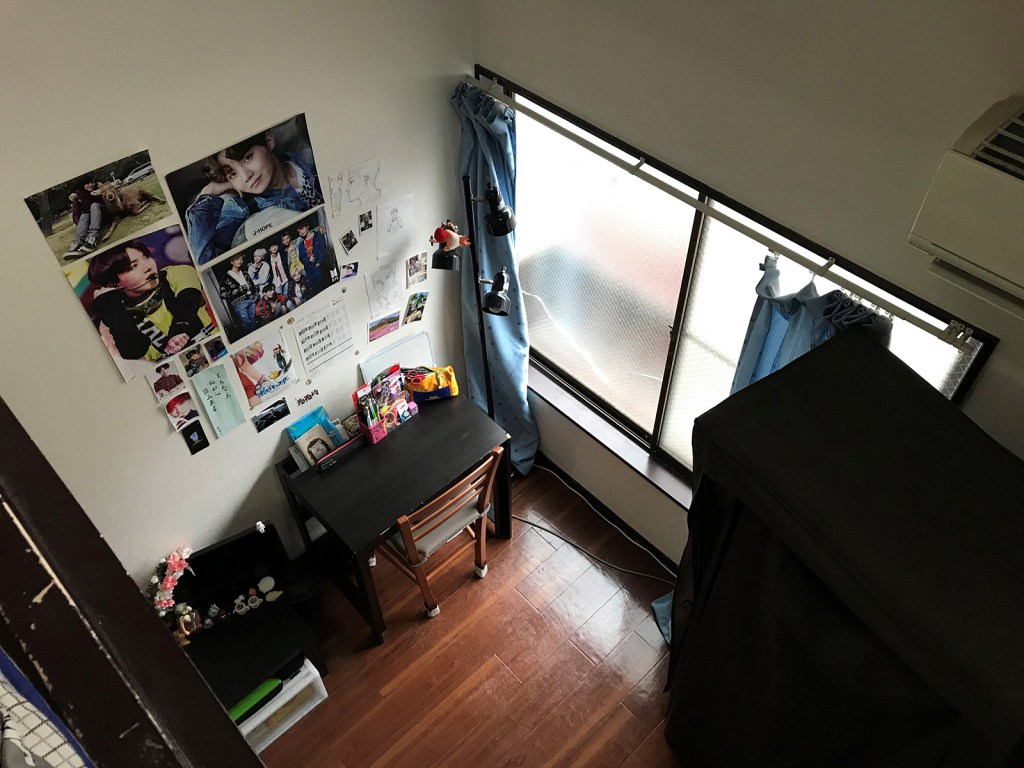
The idea of a one-room apartment (very common in big cities) did not appeal to me so much. The loft was my secret dream, because you can separate the “living” from the “sleeping”, and the ceiling is taller. Also, in one-rooms you may tend to eat on the bed, or live on the bed, which I did not like. I had the chance to find this little beauty and book it from Switzerland before going to Tokyo. You cannot imagine the fear, I asked myself many times: “What if it is horrible?”, but when I entered it was exactly how I imagined it (maybe just a little bit older than expected). It was good so in the end I kept living there for two years! I had everything I needed: An entrance with space for shoes and toilet supplies; a “unit” toilet; a kitchen with some space in between the fire and the sink (essential!); a sofa and a tv; a little (very little) desk; a wardrobe; and a second floor with a big futon (yes, I slept on a futon for two years!). After a couple of months, I added another big drawer near the sofa and two little drawers under the tv, very useful to keep food, documents, and school’s materials. I had lots of wall space so with time I also attached many posters and pictures on it (from the Korean group BTS to pictures with friends).
How could you?
For Western people a very common question is: “How could you live in there?”. Well, it is easy: First thing, you tend not to buy a lot of stuff and be happy of what you have. Then, in order: You get used to that toilet, which was a little bit uncomfortable (I prefer the special ones with sounds and stuff, who doesn’t?); you have just one pan with which you cook everything (everything!) and elaborate some funny tricks for eating, for example, vegetables and meat at the same temperature; you eat on the sofa using a chair with an ironing board on it as a table (yes!); you keep less clothes in the wardrobe organizing things per seasons, putting the things you do not currently need upstairs in the baggage; you get used to sleeping on a futon, which I think it is a good experience; you get used to using air-conditioning all year round, because in summer it is too hot and in winter it is too cold; finally, you get used to do the laundry in a coin laundry five minutes away from home, at least once every two weeks. Sounds difficult? I would not say it was the perfect life, but it was an interesting experience.
Considerations
In a place like that, it is easy to get “depressed” or feel “lonely”. It happened to me a lot, especially during my first year. Mondays are the worst for example. Also, not having anybody to rely on, because in Japan there is no such a thing as neighbors’ comradeship, you are one hundred percent on your own. When I spent time at home I used to study, work on my projects, or watch TV series. Sometimes I also went to cafes to study, not to feel alone. Then, I tried to go out and meet people as much as I could. Finally, I traveled with my parents or friends during school’s holidays. Another thing of my loft is that in summer the second floor gets too hot, and I had to move the futon downstairs, transforming it in a one-room apartment for at least three or four months a year. I also heard my neighbors a lot, since walls are super thin in old Japanese houses. However, after all, I loved that place so much and I will miss it forever.
That is all about living in tiny Japanese apartments. Are you planning to have the same experience? Feel free to share your thoughts in the comments, you can also contact me directly.
Thank you,
Elly
PS. In the radio program of 04.11.2019 I spoke about Japanese apartments (in Italian) – “Dove metto il mio letto?” with the participation of my friend Rina! (You can listen to it here, from the minute 24:18 of the second part).
Discover more about my Japanese experience: Inside Japan | Inside Japan – The Exhibition | Inside Japan – Living Tokyo! | Inside Japan – Virtual Tours!

Ciao miei cari lettori! Come state? Io bene, sto lavorando a un importante (e segreto) progetto per Elly Lakes, di cui parlerò in futuro. Oggi sono felice di annunciare che questo è il primo articolo del blog “Inside Japan”! È collegato a un video (sopra) che ho pubblicato l’altro giorno sul mio canale YouTube (ricordatevi di iscrivervi!) chiamato “Inside Japan – Welcome to My Japanese Apartment!“. Suggerisco di guardarlo fino alla fine (sì, aspettate che finiscano i titoli di coda!) c’è una sorpresa divertente. Quindi, vediamo cosa significa vivere in un loft di 16 metri quadri nel (quasi) cuore di Tokyo.
Un diverso concetto di casa
Quando ho cercato un appartamento in Giappone, sapevo che avrei dovuto scendere a compromessi sulle dimensioni. Le case giapponesi non sono famose per essere grandi. Ma c’è un’enorme differenza tra un appartamento e l’altro in termini di organizzazione dello spazio. Ho imparato che i giapponesi pensano in termini di metri quadrati, tatami (quanti tappeti di tatami possono stare in una stanza) e tipi di stanze. Un appartamento è descritto con il numero di stanze seguito da una o tutte le lettere “LDK” che significano Living (soggiorno), Dining (sala da pranzo) e Kitchen (cucina). Il mio appartamento era un 1K + Loft (una stanza con cucina + soppalco), ma potete anche trovare altre configurazioni come ad esempio 1DK (una stanza con sala da pranzo e cucina) o 1LDK (una stanza con soggiorno, sala da pranzo e cucina). La toilette è descritta separatamente e può essere composta da diverse piccole stanze (una stanza per la doccia, una per il bagno e così via) o come la mia, che era un’ “unità”, cioè una stanza compatta “tutto in uno” in cui doccia, lavandino e wc sono collegati tra loro (non vi preoccupate, l’acqua scorreva in quell’ordine preciso, non l’opposto!).
Tutto ciò di cui si ha bisogno… in un piccolo spazio
L’idea di un monolocale (molto comune nelle grandi città) non mi attirava molto. Il loft era il mio sogno segreto, perché si possono separare la zona “giorno” dalla zona “notte”, e il soffitto è più alto. Inoltre, in una stanza unica si potrebbe tendere a mangiare sul letto, o vivere sul letto, cosa che non mi piace. Ho avuto la possibilità di trovare questa piccola bellezza e prenotarla dalla Svizzera prima di andare a Tokyo. Non potete immaginare la paura, mi sono chiesta molte volte: “E se fosse orribile?”, ma quando sono entrata era esattamente come lo immaginavo (forse solo un po’ più vecchio del previsto). Era bello, quindi alla fine ho continuato a vivere lì per due anni! Avevo tutto ciò di cui avevo bisogno: un ingresso con spazio per scarpe e articoli del bagno; un bagno “unitario”, una cucina con un po’ di spazio tra il fuoco e il lavandino (essenziale!); un divano e una tv; una piccola scrivania (molto piccola); un armadio; e un secondo piano con un grande futon (sì, ho dormito su un futon per due anni!). Dopo un paio di mesi, ho aggiunto un altro cassettone vicino al divano e due piccoli cassetti sotto la tv, molto utili per conservare cibo, documenti e materiale scolastico. Avevo molto spazio sulle pareti, quindi con il tempo ho anche attaccato diversi poster e foto (dal gruppo coreano BTS alle foto con gli amici).
Come è possibile?
Per gli occidentali una domanda molto comune è: “Come hai potuto vivere lì?”. Bene, è facile: per prima cosa si tende a non comprare un sacco di cose e ad essere felice di quello che si ha. Quindi, in ordine: ci si abitua a quel bagno, che era un po’ scomodo (preferisco quelli speciali con suoni e altre cose, chi non lo vorrebbe?); si ha solo una padella con cui si cucina tutto (tutto!) e si elaborano alcuni trucchi divertenti per mangiare, ad esempio, verdure e carne alla stessa temperatura; si mangia sul divano usando una sedia con un’asse da stiro come tavolo (sì!); si tengono meno vestiti nel guardaroba organizzando le cose per stagione, mettendo nel bagaglio le cose che al momento non servono al piano di sopra; ci si abitua a dormire su un futon, che penso sia una bella esperienza; ci si abitua a usare l’aria condizionata tutto l’anno, perché in estate fa troppo caldo e in inverno fa troppo freddo; infine, ci si abitua a fare il bucato in una lavanderia a cinque minuti da casa, almeno una volta ogni due settimane. Sembra difficile? Non dico che sia stata la vita perfetta, ma è stata un’esperienza interessante.
Considerazioni
In un posto del genere, è facile essere “depressi” o sentirsi “soli”. Mi è successo molto, soprattutto durante il mio primo anno. I lunedì sono i peggiori per esempio. Inoltre, non avendo nessuno su cui fare affidamento, perché in Giappone non esiste una cosa come il cameratismo con i propri vicini, si è al cento per cento da soli. Quando passavo del tempo a casa, studiavo, lavoravo ai miei progetti o guardavo serie TV. A volte andavo anche ai caffè a studiare, per non sentirmi sola. Poi, ho cercato di uscire e incontrare persone il più possibile. Infine ho viaggiato con i miei genitori o amici durante le vacanze scolastiche. Un’altra cosa del mio loft è che in estate il secondo piano diventa troppo caldo, e dovevo spostare il futon al piano di sotto, trasformandolo in un monolocale per almeno tre o quattro mesi all’anno. Ho anche sentito molto i miei vicini, dato che i muri sono super sottili nelle vecchie case giapponesi. Comunque, dopo tutto, ho adorato quel posto e mi mancherà per sempre.
Questo è tutto riguardo il vivere in minuscoli appartamenti giapponesi. State pensando di fare la stessa esperienza? Condividete pure i vostri pensieri nei commenti, potete anche contattarmi direttamente.
Grazie,
Elly
PS. Nel programma radio del 04.11.2019 ho parlato riguardo gli appartamenti giapponesi (in italiano) – “Dove metto il mio letto?” con la partecipazione della mia amica Rina! (Riascoltate la diretta qui, dal minuto 24:18 della seconda parte).
Scoprite di più sulla mia esperienza giapponese: Inside Japan | Inside Japan – The Exhibition | Inside Japan – Living Tokyo! | Inside Japan – Virtual Tours!

 Elly Lakes
7 thoughts on “Inside Japan – Tiny Japanese Apartments!”