

Hi everyone! How are you? I almost finished my second working week in Tokyo after a three days holiday (Monday was Labor Thanksgiving Day). The short trip will be the topic of this article. You can read all day-by-day updates I dedicated to my first week from the posts on my social media. Enjoy before I will add new content!
Trip to Fuji Five Lakes
Because of its beauty and activities offered, this was not the first time I visited the Fuji Five Lakes area. I have been to lake Motosu for the Shibazakura festival, and lake Kawaguchi for FujiQ Highland and sightseeing. This time I wanted to explore lake Yamanaka, which is two hours and a half away from Shinjuku station by bus (without traffic). There, together with Jack, we explored beautiful gems such as Oshino Hakkai and Fujiyoshida.
Yamanaka Lake and near shrines
We took the bus on Saturday’s early afternoon from the Shinjuku Express Bus station and arrived in front of Yamanaka lake in the evening. We jumped off the bus in front of the lakeside, where we were greeted by an amazing fresh air! We checked-in in our traditional guesthouse and took a private bath. Near our accommodation there was a yakiniku restaurant where we had a great dinner, the food was delicious, and everybody was very polite with us. The next day we started our short holiday with a walk by the lakeside. The sky was blue and without any cloud so we could see Mount Fuji looking upon us. Yamanaka is a beautiful lake, which reminded me a lot of Switzerland, where you can rent a pedal boat or have a cruise on a huge swan-shaped ferry (it was funny to see). Not so far from the lakeside, there is a complex with two colorful shrines, exposing different omikoshi, which are the typical floats carried during matsuri, the shinto festivals. A cute thing was that one of the two shrines was dedicated to childbirth and sold omamori (lucky charms) shaped as babies!
Oshino Hakkai
One of the main reasons that made me choose Yamanaka lake this time was its vicinity to Oshino Hakkai, a preserved rural village of traditional Japanese houses with thatched roof called Minka. I have been to Shirakawago (Gifu prefecture) were I stayed in a 300-years-old Minka and it was an amazing experience. I wanted Jack to have a grasp of that kind of environment, and in Oshino Hakkai there is an open-air museum (Hannoki Bayashi Shiryokan) where it is possible to visit a couple of these houses. In the main and biggest Minka there are a lot of objects exposed, also a samurai armor and some weapons! You can also go inside the roof and look at the panorama from a small window, it was fun. This beautiful village also hosts eight ponds designated as World Heritage. The water of the ponds and the rivers is so crystal clear that you can perfectly see the algae swinging inside it and colorful fishes swimming around them. There are also little watermills, where very tasty soba and udon are prepared. Other delicacies include fish cakes, meat skewers, mochi, and dango you should try! During our first day, since there were many tourists, we just walked around the village and tried many kinds of street food, while the next morning we came back to visit the museum and eat soba.
Ninja park and Onsen
After visiting Oshino Hakkai on our first day, we walked near the river for twenty minutes circa to reach the Ninja Village. The place was more an amusement park for kids, but we had fun doing some of the games, and relaxed at the foot bath with a view of the park. Since we had still some time before going back to the guesthouse, we decided to try a near Onsen center (Benifuji no Yu). The Onsen facilities were big, divided per gender as usual, with three internal baths and two outside baths each. We spent one hour inside the facilities. At the last floor of the centre, there was an area where people could lie down on tatami and have a meal, perfect while waiting for our hair to be completely dry. We ate and relaxed there before going back (on foot) to our accommodation.
Fujiyoshida and shrines
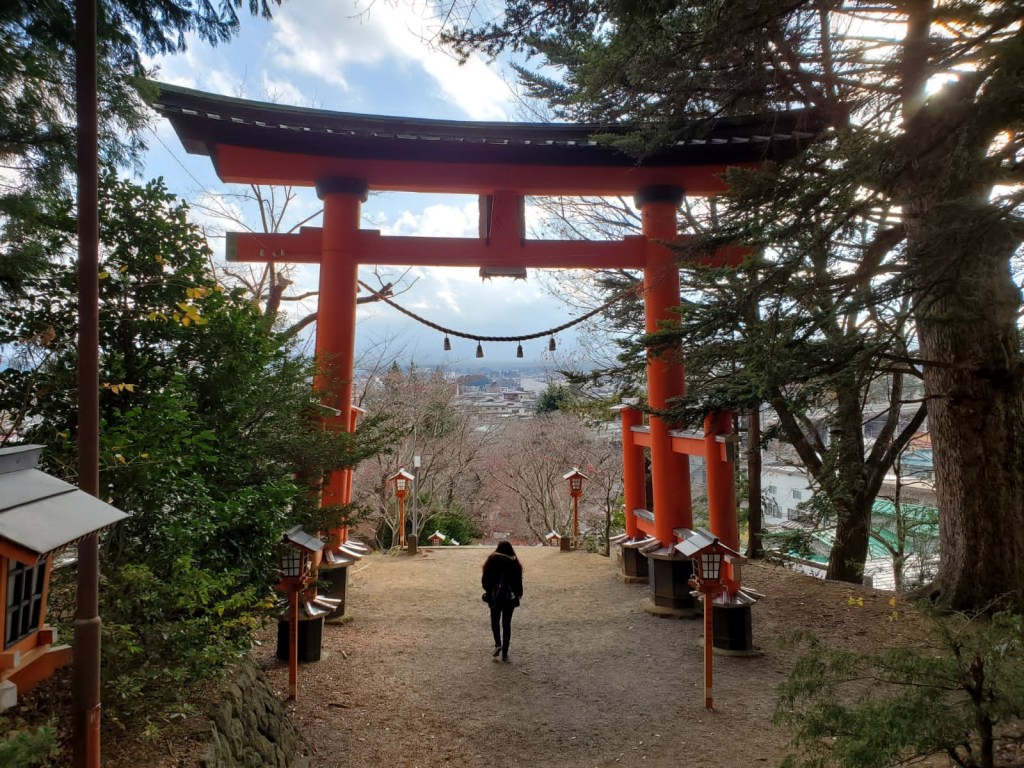
On our last day we went back to Oshino Hakkai to visit the museum and have lunch with tasty soba, and then took a bus towards Fujiyoshida. There, we left our luggage at the station and took the train to Arakurayama Sengen Park, where we saw beautiful autumn foliage. We then climbed up the stairs (there is also a road if you prefer) until we reached a shrine, and finally the beautiful Chureito pagoda. Unfortunately, that afternoon Mount Fuji was covered by the clouds, but we had the chance to take amazing pictures anyway. The view from the hill was breath-taking. We then went back to the city centre and rushed to Kitaguchi-hongu Fuji Sengen Shrine, immersed in a forest of very high trees that reminded me of Nikko. This shrine exposes beautiful omikoshi, it is surrounded by sacred trees and rocks, and hosts very big Tengu’s masks inside. I must admit it was one of the most beautiful shrines I have ever seen! We then went back to the station to catch our express bus back to Tokyo. There was so much traffic that we arrived home at night, just in time for dinner.
That same evening I also had a call with the Swiss radio tv, with which I planned the next live radio and tv program. I will be on RSI Rete Uno and RSI La 2 on December 8 at 6:45 CET, be prepared! In the meantime, you can read, listen, and watch my previous participation to the media on the Elly In The News page.
That was all for this time. I hope you enjoyed the virtual journey. Do not forget to check out my social media pages in the next days for the pictures!
Thank you for your precious support,
Elly
Discover more about my Japanese experience: Inside Japan | Inside Japan – The Exhibition | Inside Japan – Living Tokyo! | Inside Japan – Virtual Tours!

Ciao a tutti! Come state? Ho quasi finito la mia seconda settimana lavorativa a Tokyo dopo una vacanza di tre giorni (lunedì era il Giorno del Ringraziamento del Lavoro). Il breve viaggio sarà l’argomento di questo articolo. Potete leggere tutti gli aggiornamenti giorno per giorno che ho dedicato alla mia prima settimana dai post sui miei social media. Godeteveli prima che aggiunga nuovi contenuti!
Viaggio ai Cinque Laghi del Fuji
Per la sua bellezza e attività offerte, questa non era la prima volta che visitavo l’area dei cinque laghi del Fuji. Sono stata al lago Motosu per il festival degli Shibazakura e al lago Kawaguchi per FujiQ Highland e visite turistiche. Questa volta volevo esplorare il lago Yamanaka, che dista due ore e mezza dalla stazione di Shinjuku in autobus (senza traffico). Lì, insieme a Jack, abbiamo esplorato bellissime gemme come Oshino Hakkai e Fujiyoshida.
Lago Yamanaka e santuari vicini
Abbiamo preso l’autobus nel primo pomeriggio di sabato dalla stazione degli autobus Shinjuku Express e siamo arrivati di fronte al lago Yamanaka alla sera. Siamo saltati giù dall’autobus davanti al lago, dove siamo stati accolti da un’incredibile aria fresca! Abbiamo fatto il check-in nella nostra pensione tradizionale e abbiamo fatto un bagno privato. Vicino al nostro alloggio c’era un ristorante di yakiniku dove abbiamo cenato benissimo, il cibo era delizioso e tutti erano molto gentili con noi. Il giorno successivo abbiamo iniziato la nostra breve vacanza con una passeggiata in riva al lago. Il cielo era azzurro e senza alcuna nuvola così abbiamo potuto vedere il Monte Fuji che ci guardava. Yamanaka è un bellissimo lago, che mi ha ricordato molto la Svizzera, dove si può noleggiare un pedalò o fare una crociera su un enorme traghetto a forma di cigno (era divertente da vedere). Non molto lontano dalla riva del lago, c’è un complesso con due santuari colorati, che espongono diversi omikoshi, che sono i tipici carri trasportati durante i matsuri, le feste shintoiste. Una cosa carina era che uno dei due santuari era dedicato al parto e vendeva omamori (portafortuna) a forma di bebè!
Oshino Hakkai
Uno dei motivi principali che mi ha spinta a scegliere il lago Yamanaka questa volta è stata la sua vicinanza a Oshino Hakkai, un preservato villaggio rurale di case tradizionali giapponesi con tetto di paglia chiamate Minka. Sono stata a Shirakawago (prefettura di Gifu) dove ho soggiornato in una Minka di 300 anni ed è stata un’esperienza straordinaria. Volevo che Jack avesse un’idea di quel tipo di ambiente, e ad Oshino Hakkai c’è un museo a cielo aperto (Hannoki Bayashi Shiryokan) dove è possibile visitare un paio di queste case. Nella Minka principale e più grande ci sono molti oggetti esposti, anche un’armatura da samurai e alcune armi! Potete anche entrare nel tetto e guardare il panorama da una piccola finestra, è stato divertente. Questo bellissimo villaggio ospita anche otto stagni designati come Patrimonio dell’Umanità. L’acqua degli stagni e dei fiumi è così cristallina che si possono vedere perfettamente le alghe che oscillano al suo interno e pesci colorati che vi nuotano intorno. Ci sono anche piccoli mulini ad acqua, dove vengono preparati gustosissimi soba e udon. Altre prelibatezze includono torte di pesce, spiedini di carne, mochi e dango che dovreste provare! Durante il nostro primo giorno, dato che c’erano molti turisti, abbiamo semplicemente girato per il villaggio e provato molti tipi di street food, mentre la mattina dopo siamo tornati per visitare il museo e mangiare soba.
Ninja park e Onsen
Dopo aver visitato Oshino Hakkai il nostro primo giorno, abbiamo camminato vicino al fiume per circa venti minuti per raggiungere il Ninja Village. Il posto era più un parco di divertimenti per bambini, ma ci siamo divertiti a fare alcuni dei giochi e ci siamo rilassati al pediluvio con vista sul parco. Dato che avevamo ancora un po’ di tempo prima di tornare alla pensione, abbiamo deciso di provare un vicino centro Onsen (Benifuji no Yu). Le strutture Onsen erano grandi, divise per sesso come al solito, con tre bagni interni e due bagni esterni ciascuno. Abbiamo trascorso un’ora all’interno delle strutture. All’ultimo piano del centro c’era un’area dove le persone potevano sdraiarsi sul tatami e consumare i pasti, perfetta in attesa che i nostri capelli fossero completamente asciutti. Abbiamo mangiato e ci siamo rilassati prima di tornare (a piedi) al nostro alloggio.
Fujiyoshida e santuari
L’ultimo giorno siamo tornati a Oshino Hakkai per visitare il museo e pranzare con gustosi soba, e poi abbiamo preso un autobus verso Fujiyoshida. Lì, abbiamo lasciato i bagagli alla stazione e abbiamo preso il treno per Arakurayama Sengen Park, dove abbiamo visto un bellissimo fogliame autunnale. Abbiamo quindi salito le scale (c’è anche una strada se preferite) fino a raggiungere un santuario, e infine la bellissima pagoda Chureito. Sfortunatamente quel pomeriggio il Monte Fuji era coperto dalle nuvole, ma abbiamo comunque avuto la possibilità di scattare foto meravigliose. La vista dalla collina era mozzafiato. Siamo quindi tornati in centro e ci siamo precipitati al Santuario Kitaguchi-hongu Fuji Sengen, immerso in una foresta di alberi molto alti che mi ricordava Nikko. Questo santuario espone bellissimi omikoshi, è circondato da alberi e rocce sacre, e ospita al suo interno maschere di Tengu molto grandi. Devo ammettere che è stato uno dei santuari più belli che abbia mai visto! Siamo quindi tornati alla stazione per prendere il nostro autobus espresso per Tokyo. C’era così tanto traffico che siamo arrivati a casa la sera, giusto in tempo per la cena.
La sera stessa ho avuto anche una telefonata con la radio tv svizzera, con la quale ho programmato il prossimo programma radiofonico e televisivo in diretta. Sarò su RSI Rete Uno e RSI La 2 l’8 dicembre alle 6:45 CET, preparatevi! Nel frattempo, potete leggere, ascoltare e guardare la mia precedente partecipazione ai media sulla pagina Elly In The News.
Questo è tutto per questa volta. Spero vi sia piaciuto il viaggio virtuale. Non dimenticate di controllare le mie pagine social media nei prossimi giorni per le foto!
Grazie per il vostro prezioso supporto,
Elly
Scoprite di più sulla mia esperienza giapponese: Inside Japan | Inside Japan – The Exhibition | Inside Japan – Living Tokyo! | Inside Japan – Virtual Tours!

 Elly Lakes
One thought on “Japan Virtual Tours – Beautiful Gems around Mount Fuji”