

“Mum I will become crazy, do you know that?”
“Why?”
“Because I am going to study in Shin-Okubo, the Korean town.”
This is how I introduced my Japanese language school to my mother. During my first trip to Japan, my Airbnb was located in this lively and amazing Tokyo’s neighborhood. It is called “Korean town” because it is stuffed with Korean restaurants, street food, and shops. Unfortunately I have never been to Korea yet, so I am not able to judge. But I am sure of one thing: After three months and a half of going there everyday, it deeply influenced me.
From university to real life
I studied communication sciences, and I remember choosing a really interesting course about soft power and what can be called the culture war, which is not fought with guns, but with pop culture. And if in Europe we are basically embraced by US slogans like “young, wild, and free”, in Asia there are bands of boys and girls working day and night trying to be perfect, in every choreography’s move or song’s voice tone. On Asia’s pop culture ring we can find Korean Pop (KPOP) and Japanese Pop (JPOP). And for example, KPOP songs are also sung in Japanese, a tactic that allows the bands to penetrate the country of the rising sun. And I think they are succeeding in doing this.
A huge fandom and market
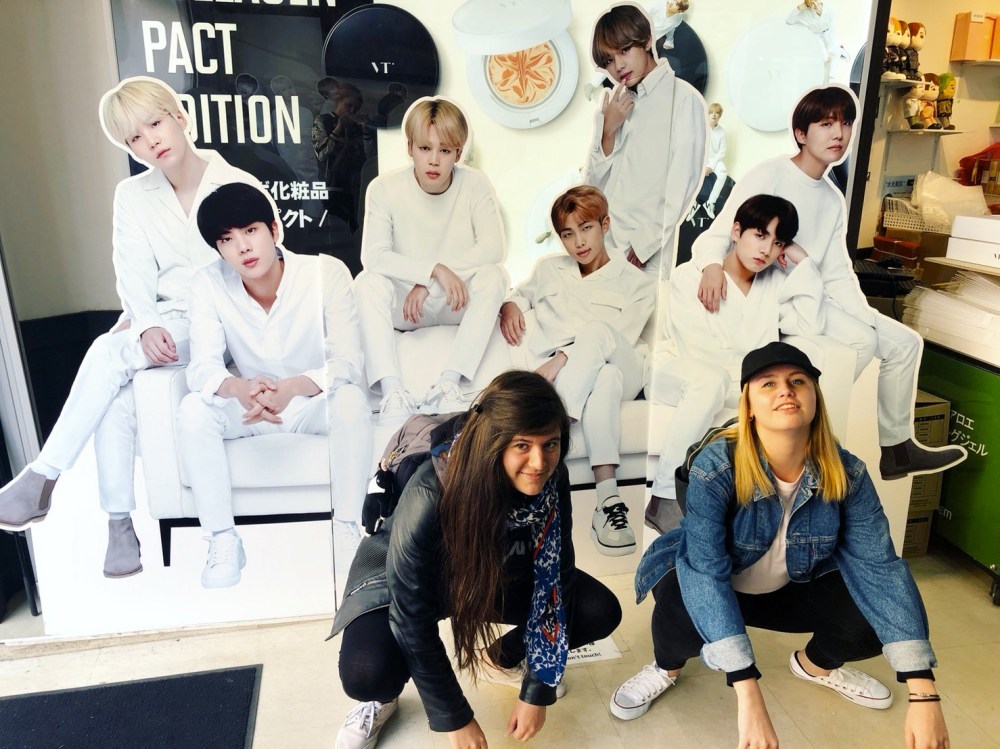
Walking in Shin-Okubo is like entering a middle school girl’s bedroom: Loud music can be heard coming from everywhere, from speakers or televisions showing the artists video clips. The artists faces can be seen on folding fans and posters, indicating the entrances of the stores. I experienced the KPOP store this year for the first time. It involves a strong fandom concept: Of your favorite band’s member (who is called ‘bias’) you can buy everything you like, from a pillow with his face, to a folder, magnet, pin, key-ring, plush toy, pen, ruler, post-it, diaries, stickers, stickers that fit your train pass, posters, and also pictures printed in every size possible. And of course there are also CDs. These stores are literally assaulted every single day, not only by girls but also by “grown ups”, it is a huge market which, I guess, can only exist in an environment like this, where the boundary between childhood and adulthood is not strongly defined.
A crazy indescribable world
Take a brief look online (e.g., write BTS, GOT7, B.A.P., Seventeen on Google search) to check what I mean by indescribable world: Tons of materials, interviews, official and unofficial videos, pictures flow into the web sphere from the hands of the artists and the ones of their fans. Every group member has at least five Instagram fans made profiles that are updated every second with new pieces of information. Interviews are gathered, re-edited and modified by fans. Why calling it “crazy”? Because these guys are super young (born in the 90es) and face a lot of pressure from the industry. This unfortunately led for example a SHINee member to commit suicide at the age of 27. We, “westerns” are not immune to this problem, since we recently lost Chester (Linkin Park) and AVICII.
I wish all these young artists to live their success in a happy way, and help each other. And I hope this article was of your interest. Let me know your opinion!
Thank you,
Elly
PS. Today BTS released their new album Love Yourself: Tear, check out theirFake Love video!
Dedicated page on my Tokyo adventure

“Mamma diventerò pazza, lo sai?”
“Perché?”
“Perché sto andando a studiare a Shin-Okubo, la città coreana.”
È così che ho presentato la mia scuola di lingua giapponese a mia madre. Durante il mio primo viaggio in Giappone, il mio Airbnb si trovava proprio in questo vivace e sorprendente quartiere di Tokyo. Viene chiamato “città coreana” perché è pieno di ristoranti, street food e negozi coreani. Sfortunatamente non sono mai stata in Corea, quindi non sono in grado di giudicare. Ma sono sicura di una cosa: dopo aver passato tre mesi e mezzo ad andare lì ogni giorno, ne sono stata profondamente influenzata.
Dall’università alla vita reale
Ho studiato scienze della comunicazione, e ricordo di aver scelto un corso davvero interessante sul soft power e su quella che può essere definita la guerra culturale, che non viene combattuta con le armi, bensì con la cultura pop. E se in Europa siamo fondamentalmente abbracciati da slogan statunitensi come “young, wild, and free”, in Asia ci sono gruppi di ragazzi e ragazze che lavorano giorno e notte nel tentativo di essere perfetti, in ogni mossa della coreografia o tono di voce della canzone. Sul ring della cultura pop in Asia possiamo quindi trovare il Korean Pop (KPOP) e il Japanese Pop (JPOP). Per esempio, le canzoni KPOP sono anche cantate in giapponese, una tattica che consente alle band di penetrare nel paese del sol levante. E penso che ci stiano riuscendo.
Una grande fandom e mercato
Camminare per Shin-Okubo è come entrare nella camera da letto di una ragazza delle medie: musica ad alto volume proveniente da ogni dove, da altoparlanti o televisioni che mostrano i videoclip degli artisti. I volti di questi ultimi possono essere visti su ventagli e manifesti, che indicano gli ingressi dei negozi. Ho sperimentato il negozio KPOP quest’anno per la prima volta. Implica un concetto molto forte di fandom: del proprio membro della band preferito (che viene chiamato ‘bias’) si può comprare tutto quello che si desidera, da un cuscino con il suo volto, a una cartelletta, calamita, spilla, portachiavi, peluche, penna , righello, post-it, diari, adesivi, adesivi che si adattano al pass ferroviario, poster e anche immagini stampate in tutte le dimensioni possibili. E ovviamente ci sono anche i CD. Questi negozi vengono letteralmente assaliti ogni giorno, non solo dalle ragazze ma anche dai “grandi”, è un mercato enorme che, immagino, può avere successo solo in un ambiente come questo, dove il confine tra infanzia ed età adulta non è fortemente definito.
Un mondo pazzesco e indescrivibile
Date una breve occhiata online (ad esempio, scrivete BTS, GOT7, B.A.P., Seventeen nella ricerca di Google) per verificare cosa intendo per mondo indescrivibile: tonnellate di materiali, interviste, video ufficiali e non ufficiali, immagini sfociano nel web dalle mani degli artisti e da quelle dei loro fan. Ogni membro del gruppo ha almeno cinque profili creati dai fan su Instagram che vengono aggiornati ogni secondo con nuove informazioni. Le interviste vengono invece raccolte, rielaborate e modificate dai fan. Perché chiamarlo “pazzo”? Perché questi ragazzi sono super giovani (nati negli anni ’90) e sono messi molto sotto pressione da parte dell’industria. Questo purtroppo ha portato ad esempio un membro della band SHINee al suicidio all’età di 27 anni. Noi “occidentali” non siamo immuni da questo problema, dal momento che abbiamo recentemente perso Chester (Linkin Park) e AVICII.
Auguro a tutti questi giovani artisti di vivere il loro successo in modo felice e di aiutarsi a vicenda. E spero che questo articolo sia stato di vostro interesse. Fatemi sapere la vostra opinione!
Grazie,
Elly
PS. Oggi i BTS hanno pubblicato il loro nuovo album Love Yourself: Tear, date un’occhiata al loro video Fake Love!
Pagina dedicata alla mia avventura a Tokyo

 Elly Lakes
Che bellooo!!
Devo assolutamente andare a
Shin-Okubo😍😍
LikeLiked by 1 person
Thanks for writing this.
LikeLiked by 1 person