

One of the best things happening when you live in a foreign country is that you are not stressed by your settled traveling time, schedules, and that you can just live. You can have routines, enjoy daily little things. This is what I wanted when I decided to come here, to live and “get bored” in Japan. Despite a (stra)ordinary life made by school, work, early wake ups, fast lunches in Kombini, late homecomings, trains full of people who exceed your personal space and that you will never see again… A life I define part of a “Japanese metropolitan culture”, I had also the chance to experience some “good old traditional Japan”, and this article focuses on tea ceremony, tanabata, and kabuki.
Tea Ceremony: Kimono and rules
To be honest, this was not my first tea ceremony. I already watched one in Switzerland, with a Japanese association based in Ticino. But, well, this was my first one in Japan, experienced in first person, wearing a beautiful kimono.
Let’s start with the dress: I guess knights in armors felt pretty much the same. You are completely wrapped in an infinite series of fabrics, ropes, and towels (that are used to flatten your curves and make your body straight). And then you have to wear the Tabi socks, and the Geta, in which your feet will never fit completely because your heels have to come out a little bit. Comfortable, right? I did not try to go to the toilet after but my friend did, and I still cannot figure out how she could cope with the situation. I assure you that your first time in Kimono will be like your first time in Japan: strange. But I suggest you to experience it, it is amazing. Once done, all the future times will be fantastic, and you will not feel like a clumsy piglet anymore, trust me.
About the tea ceremony, it is similar to the kimono-effect: I was shy and insecure, especially because there are a lot of rules to follow, let’s see them together. First, the okashi time: There are delicious cute-shaped sweets to eat before drinking tea. 1) Say “osakini” and bring the sweets’ plate in front of you with both hands; 2) Take the chopsticks with the right hand and hold them with the left hand; 3) Take one sweet and put it on a piece of kaishi (paper tissue); 4) Clean the chopsticks for the next person and put them back on the sweets’ plate; 5) Pass the plate to the next person and start eating your sweet. After this process, it finally comes the tea time: I prepared the tea by myself, shaking strongly the chasen (tea whisk) after pouring hot water and a little amount of tea powder in the bowl. Then you should: 1) Place the tea bowl in front of you and bow; 2) Take the bowl and put it on your left hand; 3) Rotate the bowl twice clock-wise; 4) Drink the tea and empty the bowl, making a sound at the third and last sip (it means you appreciated); 5) Clean the bowl edge with your thumb and forefinger from left to right; 6) Rotate the bowl back twice; 7) Put it on the table with your right hand; 8) Place it with both hands; 9) Place both hands on the table, bow once and say “arigatougozaimashita“. Yes! You did it! Would you be able to remember all these passages? 😀
Tanabata: Yukata and wishes
The yukata is a summer kimono, lighter and easier to wear but it is still a combination of fabrics, ropes and little towels. You can wear your Geta with bare feet. I felt better and more secure but still, I did not try to go to the toilet 😛
Tanabata is a beautiful festival that celebrates the meeting of the deities Orihime (Vega star) and Hikoboshi (Altair star), separated by the Milky Way and allowed to see each other only once a year on the seventh day of the seventh lunar month of the lunisolar calendar. During this festivity you are invited to write a wish on small colored pieces of paper (tanzaku) that will be hanged on bamboo (sasa), sometimes with also other cute decorations. Our wishes were then brought to the temple the day after. I hope mine will be fulfilled! In Europe we think that a wish should remain a secret, and if somebody else discovers it, it will not become true. In Japan on the contrary everybody asks about it or reads your tenzaku. Who is right? We will see!
During our evening we ate the traditional sushi bento, played games and sang the Tanabata song:
ささのは さらさら のきばに ゆれる お星さま きらきら きんぎん すなご ごしきの たんざく わたしが かいた お星さま きらきら 空から 見てる。(Sasa no ha sara-sara nokiba ni yureru ohoshi-sama kira-kira kingin sunago goshiki no tanzaku watashi ga kaita ohoshi-sama kirakira sora kara miteru.)
The bamboo leaves rustle, shaking away in the leaves. The stars twinkle on the gold and silver grains of sand. The five-colour paper strips I have already written. The stars twinkle, and there they will watch us.
Kabuki: amazing Japanese theatre
With my school we could have a discount for a kabuki show, so a class mate and I immediately took the chance to go and watch it. We could use also an “earphone guide” with translations in English.
Kabuki is more than just a theatrical representation, and it does not surprise me that it was declared by UNESCO as an “intangible cultural heritage of humanity”. Its kanji mean respectively sing (歌), dance (舞), and skill (伎), it can be then translated as “the art of singing and dancing”. Before the shows begins, a curtain covers the stage, divided in different vertical stripes with kabuki‘s colors: black, red and green (or white instead of green). The actors are all men, mostly coming from the same family, who play both male and female parts, and for the last one there are specific movements and poses to do. The stage is divided into the god’s side (right), and the human’s one (left). Music and songs can be heard from both sides, while characters’ movements are emphasized by a man who, from a corner of the stage, strikes with clappers a wooden board called Tsukeita. On the left side there is a raised corridor that links the stage to a curtain. The protagonists can come from behind that curtain or from below the corridor, using a moving trap-door. Costumes are just amazing and a great feature of kabuki is that once in a while actors stop to make the audience appreciate the scene like if it was a painting.
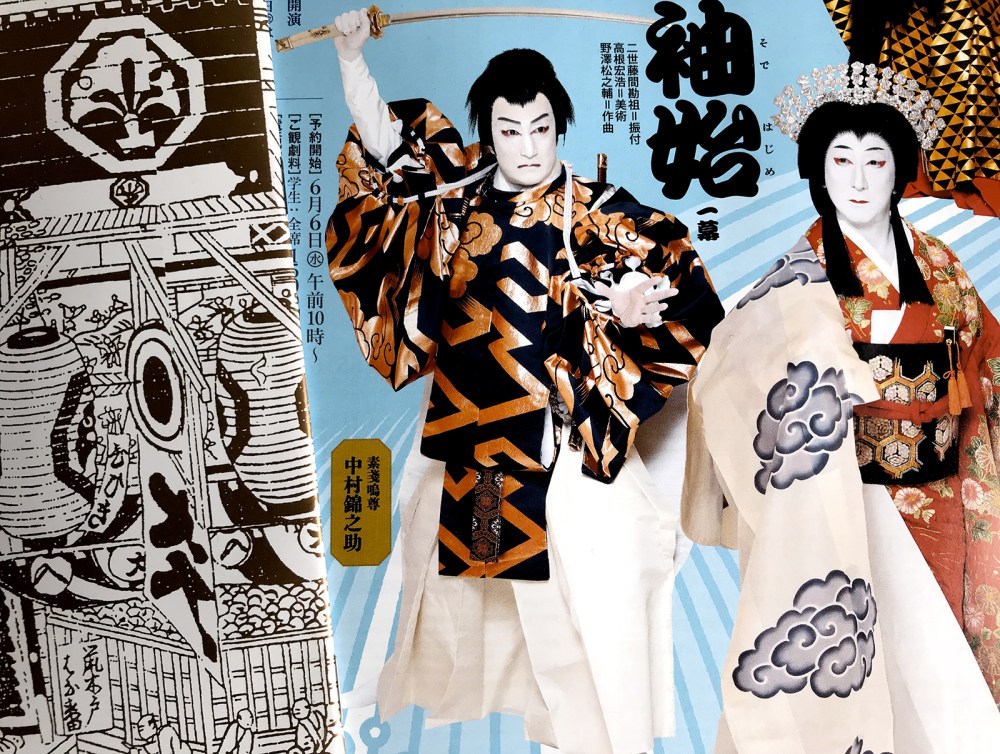
We watched Nihon Furisode Hajime, which means “the beginning of the long-sleeved kimono in Japan”, created by prince Susanoo cutting the edges of princess Inada’s kimono to save her from her fever. The dance then focused on the moment where the prince saves the princess, scarified to a fierce eight headed serpent that lives on the mountains of Izumo. After making the monster drink eight sake jars, Susanoo fights with it, cuts his back and saves the princess. It was a super slow representation and I saw some old people falling asleep in front of me. Despite some very calm moments, the fight was amazingly well made and I totally recommend watching this or other shows, because kabuki is for sure a must-see.
I will publish in the future pictures of these events on my Instagram profile, and on Facebook. I hope you enjoyed this full-immersion into Japanese culture! I promise you there will be a new one, but now it is a secret 😀
Thank you,
Elly
Discover more about Inside Japan – The Exhibition | Inside Japan – Living Tokyo! | Inside Japan – Virtual Tours!

Una delle cose migliori che succedono quando si vive in un paese straniero è che non si è stressati dai propri tempi di viaggio, da orari stabiliti, e che si può semplicemente vivere. Si può avere una routine, godersi le piccole cose quotidiane. Questo è quello che volevo quando ho deciso di venire qui, volevo vivere e “annoiarmi” in Giappone. Nonostante una (stra)ordinaria vita fatta di scuola, lavoro, alzatacce, pranzi veloci nei Kombini, ritorni a casa tardivi, treni pieni di persone che oltrepassano il vostro spazio personale e che non vedrete mai più… Una vita che definisco parte di una “cultura metropolitana giapponese”, ho avuto anche la possibilità di fare esperienza del “buon vecchio Giappone tradizionale” e questo articolo si concentra sulla cerimonia del tè, sul tanabata e il kabuki.
Cerimonia del tè: Kimono e regole
A essere onesti, questa non è stata la mia prima cerimonia del tè. Ne ho già vista una in Svizzera, fatta da un’associazione giapponese con sede in Ticino. Ma, beh, questa è stata la mia prima in Giappone, vissuta in prima persona, indossando un bellissimo kimono.
Iniziamo con il vestito: immagino che i cavalieri in armatura si sentissero più o meno allo stesso modo. Si è completamente avvolte in una serie infinita di tessuti, corde e asciugamani (che vengono usati per appiattire le curve e rendere il corpo dritto). E poi bisogna indossare i calzini Tabi e le Geta, in cui i piedi non entreranno mai completamente perché i talloni devono uscire un po’. Comodo, vero? Non ho provato ad andare in bagno dopo, ma la mia amica lo ha fatto, e ancora non riesco a capire come ha potuto far fronte alla situazione. Vi assicuro che la vostra prima volta in Kimono sarà come la vostra prima volta in Giappone: strana. Ma vi suggerisco di provarlo, è incredibile. Una volta fatto, tutte le volte future saranno fantastiche, e non vi sentirete più come un maialino maldestro, fidatevi di me.
Per quanto riguarda la cerimonia del tè, è simile all’effetto kimono: ero timida e insicura, soprattutto perché ci sono molte regole da seguire, vediamole insieme. In primo luogo, c’è il momento degli okashi: ci sono deliziosi dolci molto carini da mangiare prima di bere il tè. 1) Dite “osakini” e portate il piatto dei dolci davanti a voi con entrambe le mani; 2) Prendete le bacchette con la mano destra e tenetele con la mano sinistra; 3) Prendete un dolce e mettetelo su un pezzo di kaishi (carta velina); 4) Pulite le bacchette per la prossima persona e rimettetele sul piatto dei dolci; 5) Passate il piatto alla persona successiva e iniziate a mangiare il vostro dolce. Dopo questo processo, arriva finalmente l’ora del tè: io ho preparato il tè da sola, scuotendo forte il chasen (frusta del tè) dopo aver versato acqua calda e una piccola quantità di tè in polvere nella ciotola. Quindi dovreste: 1) Mettere la ciotola davanti a voi e inchinarvi; 2) Prendere la ciotola e metterla sulla mano sinistra; 3) Ruotare la ciotola due volte in senso orario; 4) Bere il tè e svuotare la ciotola, facendo un suono al terzo e ultimo sorso (significa che avete apprezzato); 5) Pulire il bordo della ciotola con il pollice e l’indice da sinistra a destra; 6) Ruotare indietro la ciotola due volte; 7) Metterla sul tavolo con la mano destra; 8) Posizionarla con entrambe le mani; 9) Appoggiare entrambe le mani sul tavolo, inchinarsi una volta e dite “arigatougozaimashita“. Sì! Ce l’avete fatta! Sareste in grado di ricordare tutti questi passaggi? 😀
Tanabata: Yukata e desideri
Lo yukata è un kimono estivo, più leggero e facile da indossare ma è comunque una combinazione di tessuti, corde e piccoli asciugamani. Potete indossare le Geta con i piedi nudi. Mi sono sentita meglio e più sicura, ma ancora, non ho provato ad andare in bagno 😛
Il Tanabata è un bellissimo festival che celebra l’incontro delle divinità Orihime (stella Vega) e Hikoboshi (stella Altair), separate dalla Via Lattea e con il permesso di vedersi solo una volta all’anno, il settimo giorno del settimo mese lunare del calendario lunisolare. Durante questa festa si è invitati a scrivere un desiderio su piccoli pezzi di carta colorata (tanzaku) che saranno appesi sul bambù (sasa), a volte con altre decorazioni carine. I nostri desideri sono stati poi portati al tempio il giorno successivo. Spero che il mio si avveri! In Europa pensiamo che un desiderio debba rimanere un segreto, e se qualcun altro lo dovesse scoprire, non diventerà realtà. In Giappone, al contrario, tutti vi chiedono o leggono il vostro tenzaku. Chi ha ragione? Vedremo!
Durante la nostra serata abbiamo mangiato il tradizionale sushi bento, fatto dei giochi di società e cantato la canzone del Tanabata:
ささのは さらさら のきばに ゆれる お星さま きらきら きんぎん すなご ごしきの たんざく わたしが かいた お星さま きらきら 空から 見てる。(Sasa no ha sara-sara nokiba ni yureru ohoshi-sama kira-kira kingin sunago goshiki no tanzaku watashi ga kaita ohoshi-sama kirakira sora kara miteru.)
Le foglie di bambù frusciano, scuotendosi nelle foglie. Le stelle brillano sui grani dorati e argentati della sabbia. Le strisce di carta a cinque colori che ho già scritto. Le stelle brillano, e lì ci guarderanno.
Kabuki: incredibile teatro giapponese
Con la mia scuola potevamo avere uno sconto per uno spettacolo di kabuki, quindi un compagno di classe e io abbiamo subito colto l’occasione per andare a vederlo. Abbiamo potuto usare anche una “guida con auricolari” con traduzioni in inglese.
Il Kabuki è più di una semplice rappresentazione teatrale e non mi sorprende che sia stato dichiarato dall’UNESCO “patrimonio culturale immateriale dell’umanità”. I suoi kanji significano rispettivamente cantare (歌), danzare (舞) e abilità (伎), può quindi essere tradotto come “l’arte di cantare e ballare”. Prima che lo spettacolo inizi, una tenda copre il palco, divisa in diverse strisce verticali con i colori del kabuki: nero, rosso e verde (o bianco invece che verde). Gli attori sono tutti uomini, perlopiù provenienti dalla stessa famiglia, che recitano parti sia maschili che femminili, e per queste ultime ci sono movimenti e pose specifici da fare. Il palcoscenico è diviso nella parte delle divinità (destra) e in quella dell’uomo (sinistra). La musica e le canzoni possono essere ascoltate da entrambi i lati, mentre i movimenti dei personaggi sono enfatizzati da un uomo che, da un angolo del palcoscenico, colpisce con delle nacchere una tavola di legno chiamata Tsukeita. Sul lato sinistro c’è un corridoio rialzato che collega il palcoscenico a una tenda. I protagonisti possono venire da dietro quella tenda o da sotto il corridoio, usando una botola in movimento. I costumi sono semplicemente fantastici e una grande caratteristica del kabuki è che ogni tanto gli attori si fermano per far apprezzare al pubblico la scena come se fosse un dipinto.
Abbiamo visto Nihon Furisode Hajime, che significa “l’inizio del kimono a maniche lunghe in Giappone”, creato dal principe Susanoo tagliando i bordi del kimono della principessa Inada per salvarla dalla sua febbre. La danza si è poi concentrata sul momento in cui il principe salva la principessa, scarificata a un feroce serpente a otto teste che vive sulle montagne di Izumo. Dopo aver fatto bere al mostro otto giare di sake, Susanoo combatte con esso, gli taglia la schiena e salva la principessa. Era una rappresentazione molto lenta e ho visto alcuni anziani addormentarsi davanti a me. Nonostante alcuni momenti calmi, il combattimento era incredibilmente ben fatto e consiglio vivamente di assistere a questo o altri spettacoli, perché il kabuki è senza dubbio assolutamente da vedere.
Pubblicherò in futuro le foto di questi eventi sul mio profilo Instagram e su Facebook. Spero vi sia piaciuta questa full-immersion nella cultura giapponese! Vi prometto che ce ne sarà una nuovoa, ma per adesso è un segreto 😀
Grazie,
Elly
Scopri di più riguardo Inside Japan – The Exhibition | Inside Japan – Living Tokyo! | Inside Japan – Virtual Tours!

 Elly Lakes
Molto interessante tutto, io non riuscirei più a memorizzare tutti i passaggi per poter finalmente bermi il te in pace… ma potrei provarci comunque! Tienici aggiornati sempre sulle tue esperienze in terra nipponica, se non potremo viverle in prima persona almeno lo avremo fatto attraverso i tuoi occhi! Grazie!
LikeLiked by 1 person
Ci hanno dato un foglietto con i passaggi e ci hanno anche aiutato a voce 🙂 Grazie mille!
LikeLike